

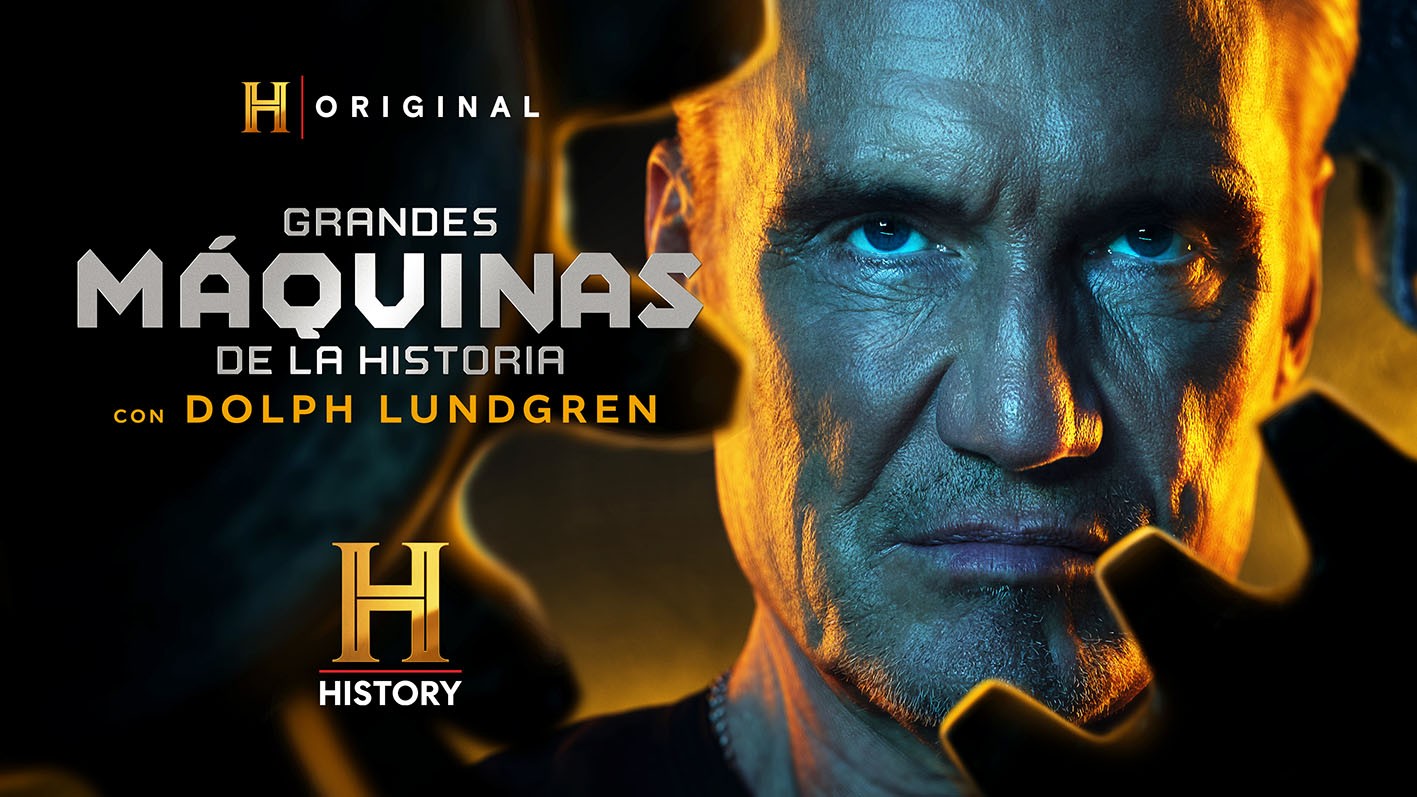
HISTORY premieres “HISTORY’S GREATEST MACHINES WITH DOLPH LUNDGREN” in Latin America, a new eight-episode series hosted and executive produced by actor, director, and producer Dolph Lundgren. The series travels through centuries of innovation to uncover the engineering, stories, and minds behind some of the most extraordinary machines that have transformed history.
Known worldwide as one of the great icons of action cinema and for his unforgettable portrayal of Ivan Drago in “Rocky IV,” Lundgren brings a lesser-known side of his personal story to this journey: before making it to Hollywood, he studied chemical engineering, earned a master’s degree in the field, and received a Fulbright scholarship to continue his studies at the prestigious Massachusetts Institute of Technology (MIT).
Throughout the series, Lundgren explores the challenges that drove engineers, inventors, and visionaries to push technology beyond limits that once seemed impossible. From machines designed to dominate battlefields to developments that made it possible to reach the Moon, cross oceans, travel at unprecedented speeds, explore the depths of the planet, or forever change the way people communicate and move around, each episode reconstructs how these machines were created, the problems their designers had to solve, and how they ultimately changed the course of history.
Through historical context supported by archival footage and AI-generated recreations, the production also offers insight into how these machines work and the engineering and design innovations that made their development possible, with contributions from experts and renowned collaborators including astrophysicist Hakeem Oluseyi, physicist Paul Sutter, historians Don Wildman and Martin K.A. Morgan, History professor Natalia Mehlman Petrzela, and Jeopardy! author and personality Austin Rogers.
As part of the highly anticipated premiere, HISTORY held an exclusive virtual press event for Latin American media on September 8, featuring Dolph Lundgren. During the event, the actor, executive producer, and host of the series discussed his personal connection to engineering and technology, how he became involved with “HISTORY’S GREATEST MACHINES,” the role machines have played in human evolution, and his views on the future, artificial intelligence, and robotics.
Speaking about his connection to the series and the opportunity to show audiences a different side of himself from the one they know from his action-film career, Lundgren explained: “Well, I hope people can see me in a different context, trying to bring them closer to these technological wonders and explain how the machines work. Obviously, in my film career, I don’t usually play characters like that. I’m more of an action guy: I drive a truck or a motorcycle, carry a gun or something like that, do martial arts. But in this series, I have a more explanatory role, so perhaps people can see me in a different way. I hope so.”
Reflecting on how much we depend on technology even in our everyday lives, he said: “Everyone is focused on artificial intelligence and perhaps space exploration. But in our lives, there are so many machines we depend on to survive, and it’s easy to forget that. And it’s important to be reminded of it.”
He also discussed the human drive behind these creations: “I think most machines were created for survival purposes. If there is a need to survive a war, heat a space, move faster; maybe someone wants to be able to make more money, or a country is being threatened by an aggressor and they’re trying to develop a new airplane or a new weapon. Or there’s a space race and two countries are trying to outdo each other.” He added: “I think machines were invented to make our lives easier, to allow us to live more comfortably and also to defend ourselves. So, basically, they are part of the natural evolution of the species.”
On artificial intelligence and robotics, Lundgren said: “I think artificial intelligence and robotics are going to be useful and they’re going to be fantastic in the future. People are going to look back at you and me and say, ‘Look at those poor guys from the 2020s. How could they survive like that? It was such a difficult life.’ People are going to look back on these times romantically: when you went shopping, drove your own car and, well, people didn’t live to be 120 years old. Things like that.”
When asked who he considers the greatest inventor of all time, he replied: “I think the greatest inventor is the human mind. Us. We are the greatest inventors.”
In one of the most personal moments of the conversation, Lundgren compared his own career to a machine: “I think it would be some kind of armored vehicle that kept moving slowly but steadily, taking fire from different types of artillery, having some mechanical problems and facing many challenges, but still moving forward. It just keeps pushing forward, like a tank or something.”
Finally, speaking about what drives him to continue exploring new paths, he said: “Ever since I was very young, I always felt that life was quite short and valuable. And I wanted to make the most of it. I actually didn’t know what I was going to end up doing. I simply took whatever came in front of me.” He concluded: “I like learning. So I suppose there are probably two things behind my journey. One is learning about our planet and humanity. And the most important one is learning about myself, because there is that old saying: ‘I am a river that I am learning to cross.’”
One episode delves into the evolution of rockets, from the ancient Korean hwacha, capable of simultaneously firing up to 200 gunpowder-propelled arrows, through the weapons developed by Nazi Germany during World War II, such as the V-2, dubbed “Vengeance 2” by Hitler, a deadly and incredibly fast rocket that became the first human-made object to reach space, to one of the greatest engineering achievements of the 20th century: NASA’s Saturn V. The series reconstructs the development of the massive three-stage rocket and the historic launch of Apollo 11 on July 16, 1969, when Neil Armstrong, Buzz Aldrin, and Michael Collins set out for the Moon aboard a machine capable of generating approximately 7.5 million pounds of thrust. Nearly 76 hours later, the mission reached lunar orbit before Armstrong and Aldrin descended to the surface.
Decades after humans first reached the Moon, that journey continues into a new era of space exploration and the challenge of creating truly reusable rockets. The series examines the development of the Falcon 9, the rocket created by technology company SpaceX and designed so that its first stage could separate, perform a controlled descent, and land vertically for reuse. The system combines onboard computers, grid fins, and engine thrust to correct its trajectory during the descent and guide itself toward the landing platform. After numerous failed attempts, explosions, and multimillion-dollar losses, SpaceX successfully landed the first stage vertically in 2015.
The race for speed opens another universe of stories. Lundgren presents the Thrust SSC, the land vehicle that in 1997 became the first to break the sound barrier, reaching 763 miles per hour — more than 1,200 kilometers per hour — and producing a sonic boom; the legendary Concorde, the supersonic passenger aircraft that revolutionized commercial travel; and the Shanghai Maglev, the train that uses powerful magnetic fields to levitate above its track, virtually eliminating friction, and which exceeded 500 kilometers per hour during testing.
But the fastest machine in the series is not found on Earth. NASA’s Parker Solar Probe, launched in 2018 to approach and study the Sun, was designed to exceed 430,000 miles per hour — more than 690,000 kilometers per hour — a speed that, by comparison, could cover the distance between New York and Tokyo in less than a minute. To achieve this, the probe uses Venus’s gravity as a kind of “slingshot” to progressively increase its speed as it approaches the Sun.
The series also explores some of the largest machines ever built. Among them are the enormous Antonov An-225, developed by the Soviet Union to carry the Buran space shuttle on top of its fuselage and considered the heaviest aircraft ever built; the Lun-class ekranoplan, a colossal 400-ton Soviet machine designed to travel just a few meters above the surface of the sea at more than 480 kilometers per hour; and the monumental Helepolis, a mobile siege tower approximately 40 meters tall, equipped with battering rams, catapults, and multiple levels for soldiers, designed to advance toward the walls of Rhodes and breach its defenses.
They are joined by equally monumental feats of civil engineering, such as the Hoover Dam, built to control flooding from the unpredictable Colorado River and generate the electricity that would fuel the growth of the American West; and Big Bertha, Seattle’s enormous tunnel-boring machine, more than 17 meters in diameter and nearly 100 meters long, with 13 million pounds of excavation force, built to create the tunnel that would replace the Alaskan Way Viaduct while simultaneously installing its concrete walls.
The oceans also take center stage. “HISTORY’S GREATEST MACHINES” travels from the canoes that enabled ancient Polynesian navigators to cross thousands of kilometers of the Pacific to the German U-boats of World War II and the USS Enterprise, the U.S. Navy’s first nuclear-powered aircraft carrier. The series also revisits James Cameron’s extraordinary expedition to the Mariana Trench aboard the Deepsea Challenger, the vessel he used in 2012 to make a solo descent to Challenger Deep, the deepest point on Earth, where he was able to collect sediment samples, record high-definition images, and search for signs of life.
Another episode enters the world of espionage, where reality can be even more surprising than fiction. Among the technologies featured is the legendary SR-71 Blackbird spy plane, capable of flying at more than three times the speed of sound and, throughout its 30 years of service and more than 4,000 recorded encounters with missiles, never shot down; as well as tiny automated cameras less than two inches long that the CIA once placed on messenger pigeons to gather enemy intelligence. The episode also explores the history of other devices created to transmit information without arousing suspicion, such as radios hidden inside tobacco pipes that allowed agents to receive messages without cables or headphones. Using a bone-conduction system, the agent would bite the pipe, allowing vibrations to travel through his teeth and jaw to the inner ear, enabling him to hear the communication.
The technology used in missions considered impossible also receives its own chapter. There, Lundgren explores everything from the stealth helicopter used by SEAL Team Six during the operation against Osama bin Laden to the Osprey, capable of taking off and hovering like a helicopter before transforming into an airplane in midair; underwater vehicles used by the SEALs; and the Black Hornet, a tiny reconnaissance drone that fits in the palm of a hand and can enter doors, hallways, and windows to transmit live images while soldiers remain protected.
The series also expands the concept of a “machine” to focus on inventions that profoundly changed everyday life. From Johannes Gutenberg’s printing press, which made it possible to reproduce books on a massive scale and bring ideas to an increasingly broad audience, to Henry Ford’s Model T, which made automobiles increasingly accessible; the Apple II, developed by Steve Wozniak and Steve Jobs, which became a driving force behind the personal computer revolution and helped transform a massive and intimidating technology into something accessible; and the International Space Station, whose construction began in 1998, required more than 30 missions and a decade of spacewalks, and became the largest structure ever assembled by humans in space.
Spanning thousands of years, “HISTORY’S GREATEST MACHINES WITH DOLPH LUNDGREN” focuses not only on the size, power, or speed of these creations, but also on the human ambition that made them possible: the need to go farther, faster, deeper, or find a solution where none seemed to exist.
ABOUT DOLPH LUNDGREN
Long before becoming one of the most recognizable faces in action cinema, Dolph Lundgren had embarked on a very different path. Born in Stockholm, Sweden, after completing his military service, he followed in his father’s footsteps and began studying engineering.
Lundgren studied at Washington State University and Clemson University before earning a degree in Chemical Engineering from the Royal Institute of Technology in Stockholm. He later earned a master’s degree in Chemical Engineering from the University of Sydney in Australia. His academic performance earned him a prestigious Fulbright scholarship to continue his studies at the Massachusetts Institute of Technology (MIT), a stage of his education that Lundgren himself has referenced when discussing his connection to engineering.
At the same time, Lundgren developed a successful career in martial arts. He earned a third-degree black belt in Kyokushin karate, served as captain of the Swedish team, and won titles at European championships and in Australia.
After moving to New York and working as a model, he began pursuing acting. His film debut came in 1985 with A View to a Kill, part of the James Bond franchise, but that same year his life changed forever when, after a nine-month casting process involving thousands of candidates, Sylvester Stallone chose him to play Soviet boxer Ivan Drago in Rocky IV. The role immediately turned him into a globally recognized star.
From there, he built an extensive international career that includes titles such as Masters of the Universe, The Punisher, Universal Soldier, and The Expendables franchise, as well as appearances in Aquaman and a return to the role of Ivan Drago decades later in Creed II. Alongside his work as an actor, he has also worked as a director, screenwriter, and producer.
Now, he connects his extensive career in front of the camera with another, lesser-known side of his life: his training as an engineer. In each episode, Lundgren explores some of the most extraordinary machines in history, examining how they work, learning about the innovations that made their development possible, and discovering how these advances helped transform the world.
“HISTORY’S GREATEST MACHINES WITH DOLPH LUNDGREN” EPISODE SYNOPSES
AERIAL ATTACKERS (#01)
WEDNESDAY, OCTOBER 28 (COL) / FRIDAY, OCTOBER 30 (ARG) / WEDNESDAY, NOVEMBER 4 (MEX)
From ancient catapults to stealth drones, controlling the skies has always been key to winning a war. Dolph Lundgren explores the machines that transformed aerial combat: the Cold War atomic cannon, the B-17 bomber, and the F-35 stealth fighter, symbols of innovation and military power.
MISSION CRITICAL (#02)
WEDNESDAY, NOVEMBER 4 (COL) / FRIDAY, NOVEMBER 6 (ARG) / WEDNESDAY, NOVEMBER 11 (MEX)
When a mission seems impossible, special forces step in. We revisit the machines behind some of history’s boldest operations: the stealth helicopter used against Bin Laden, a silent carbine from World War II, and an insect-sized drone.
MONSTER MACHINES (#03)
WEDNESDAY, NOVEMBER 11 (COL) / FRIDAY, NOVEMBER 13 (ARG) / WEDNESDAY, NOVEMBER 18 (MEX)
Some machines push the limits of size. Dolph Lundgren explores legendary giants such as the Antonov An-225, the largest aircraft ever built; the 200-ton Maus tank designed for Hitler; and Bigfoot, the monster truck that sparked a worldwide phenomenon.
DEVICES OF DECEPTION (#04)
WEDNESDAY, NOVEMBER 18 (COL) / FRIDAY, NOVEMBER 20 (ARG) / WEDNESDAY, NOVEMBER 25 (MEX)
Dolph Lundgren reveals the secret devices that changed the course of wars: CIA cameras hidden on pigeons, bone-conduction radios concealed inside pipes, the deadly “heart attack gun,” and the Enigma machine, central to one of the greatest intelligence battles in history.
BREAKTHROUGH BOATS (#05)
WEDNESDAY, NOVEMBER 25 (COL) / FRIDAY, NOVEMBER 27 (ARG) / WEDNESDAY, DECEMBER 2 (MEX)
Dominating a planet covered by 70% water requires extraordinary machines. Dolph Lundgren explores German U-boats, ancient canoes that crossed the Pacific, James Cameron’s Deepsea Challenger, and a nuclear-powered aircraft carrier that came dangerously close to triggering a nuclear war.
WORLD’S FASTEST (#06)
WEDNESDAY, DECEMBER 2 (COL) / FRIDAY, DECEMBER 4 (ARG) / WEDNESDAY, DECEMBER 9 (MEX)
Dolph Lundgren presents machines that broke every speed record: the Thrust SSC, the first land vehicle to break the sound barrier; the Concorde, which revolutionized commercial air travel; and NASA’s Parker Solar Probe, the fastest human-made object in history.
ROCKET SCIENCE (#07)
WEDNESDAY, DECEMBER 9 (COL) / FRIDAY, DECEMBER 11 (ARG) / WEDNESDAY, DECEMBER 16 (MEX)
Rockets transformed warfare and exploration. Dolph Lundgren looks back at decisive inventions such as the Korean hwacha, the Saturn V that carried humans to the Moon, and Martin-Baker’s rocket-powered ejection seat, which has saved thousands of lives in extreme situations.
CHANGE AGENTS (#08)
WEDNESDAY, DECEMBER 16 (COL) / FRIDAY, DECEMBER 18 (ARG) / WEDNESDAY, DECEMBER 23 (MEX)
Wars were not always what changed the world; sometimes, all it took was a great idea. Dolph Lundgren examines revolutionary machines such as the printing press, the Apple II computer, and the Ford Model T, inventions that forever transformed communication, technology, and transportation.